
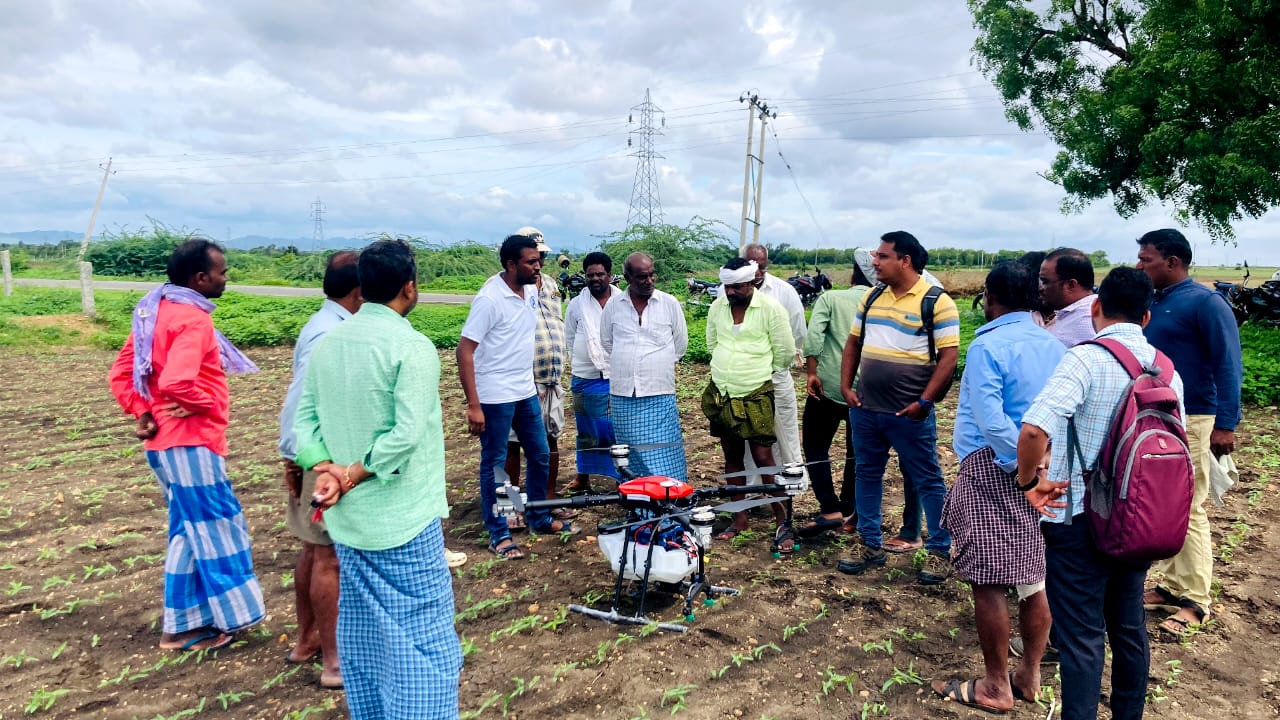
Direct Answer
Drone spraying can benefit farmers through speed, precision, labor reduction, safety, and resource optimization. The strongest results come when trained operators use the right application method for the crop and field condition.
Farming has always depended on timing. A delay in pesticide spraying, uneven fertilizer application, or shortage of labor can directly affect crop health and yield.
Across Karnataka and many parts of India, farmers are increasingly adopting agriculture drones to solve these challenges. What was once considered advanced technology is now becoming a practical farming tool.
One common question farmers ask is: "Is drone spraying really beneficial compared to traditional methods?" For many operations, the answer is yes.
What Is Drone Spraying?
Drone spraying involves using unmanned aerial systems equipped with tanks, pumps, and spray nozzles to apply crop inputs across planned routes.
- Pesticides
- Herbicides
- Fertilizers
- Micronutrients
- Crop protection chemicals
1. Significant Time Saving
One of the biggest advantages of drone spraying is speed. Traditional spraying often requires manual labor, walking across fields, and a large time investment.
Drone operations can complete spraying much faster, which becomes critical during pest outbreaks, disease control periods, and seasonal spraying windows.
Faster Coverage Means Better Farm Management
Delayed spraying can reduce effectiveness. Quick coverage allows farmers to respond faster, protect crops sooner, and manage multiple fields efficiently.
Time saved often becomes one of the strongest reasons for adoption.
2. Reduced Labor Dependency
Agriculture labor shortages continue increasing in many regions. Finding workers during peak seasons can become difficult and expensive.
Drone spraying reduces dependence on manual sprayers, large field teams, and seasonal labor availability. This becomes valuable during urgent operations.
3. Improved Safety for Farmers
Traditional spraying often exposes workers directly to chemicals. Long-term exposure may increase health risks.
Drone spraying helps reduce direct contact because operators maintain distance during application, reducing exposure to pesticides, herbicides, and chemical vapors.
4. Better Spray Uniformity
Manual spraying quality can vary depending on operator fatigue or technique. Drone systems aim for more consistent coverage.
- Better crop protection
- Improved treatment effectiveness
- More consistent resource utilization
5. Lower Water Consumption
Many drone systems use lower water volumes compared to conventional spraying methods. This can reduce water requirement, improve efficiency, and simplify transport logistics.
Water savings can matter significantly in water-stressed regions.
6. Reduced Chemical Wastage
Over-application increases cost, while under-application reduces effectiveness. Precision spraying helps optimize usage.
- Better targeting
- Reduced excess usage
- Lower operational waste
7. Access to Difficult Terrain
Certain fields are challenging for manual operations, including wet fields, uneven terrain, dense crops, and tall crops.
Drone spraying improves accessibility in such conditions.
8. Increased Productivity
Productivity is not only about yield. It also involves time management, labor efficiency, faster operations, and better resource use.
When multiple improvements combine, overall farm productivity can improve.
9. Useful for Large Acreage Farming
Large farms often face operational delays during spraying cycles. Drone systems help manage larger areas more efficiently.
Benefits become more noticeable as acreage increases.
10. Supports Precision Agriculture
Modern farming increasingly relies on data and targeted operations. Drone technology contributes toward precision application, efficient resource use, and smarter farm management practices.
Precision agriculture continues growing in India.
Drone Spraying vs Manual Spraying
| Factor | Manual Spraying | Drone Spraying |
|---|---|---|
| Speed | Slower | Faster |
| Labor Requirement | High | Lower |
| Chemical Exposure | Higher | Reduced |
| Coverage Uniformity | Variable | Better consistency |
| Water Usage | More | Lower |
| Large Acreage Suitability | Difficult | More efficient |
Each method has applications depending on farm conditions.
Is Drone Spraying Suitable for All Farmers?
Not always. Suitability depends on farm size, crop type, budget, and frequency of spraying.
For smaller farms, hiring drone services may be more economical than ownership.
Crops Commonly Using Drone Spraying
- Paddy
- Cotton
- Sugarcane
- Maize
- Tomato
- Chilli
- Banana
- Pulses
- Horticulture crops
Frequently Asked Questions
Does drone spraying save money?
Savings often come through reduced labor, optimized chemical usage, and faster operations.
Is drone spraying safe?
Proper operation and trained handling improve safety considerably.
Can small farmers use drone services?
Yes. Many service providers support smaller acreages.
Is drone spraying faster than manual spraying?
In many situations, drone operations complete spraying significantly faster.
Final Thoughts
Drone spraying is changing how many farming operations are managed. The technology offers advantages in speed, safety, efficiency, and resource optimization, particularly for larger or time-sensitive operations.
However, drones are tools, not complete replacements for farming knowledge. Their effectiveness depends on proper planning, trained operators, and suitable application methods.
For farmers exploring modern agriculture practices, understanding the real benefits rather than only the technology itself is important before making decisions.
Interested in agriculture drone spraying or precision farming solutions in Karnataka?